
Steve Tyler spent decades as a Clinical Social Worker in Indiana. He listened to people for a living, day after day. So that job trains you to hear hard things without flinching. And it makes sense, then, that Man It’s All One Big Thing reads less like a performance. Instead, it feels more like a friend telling you the truth over coffee.
What Man It’s All One Big Thing Owes To A Career Spent Listening
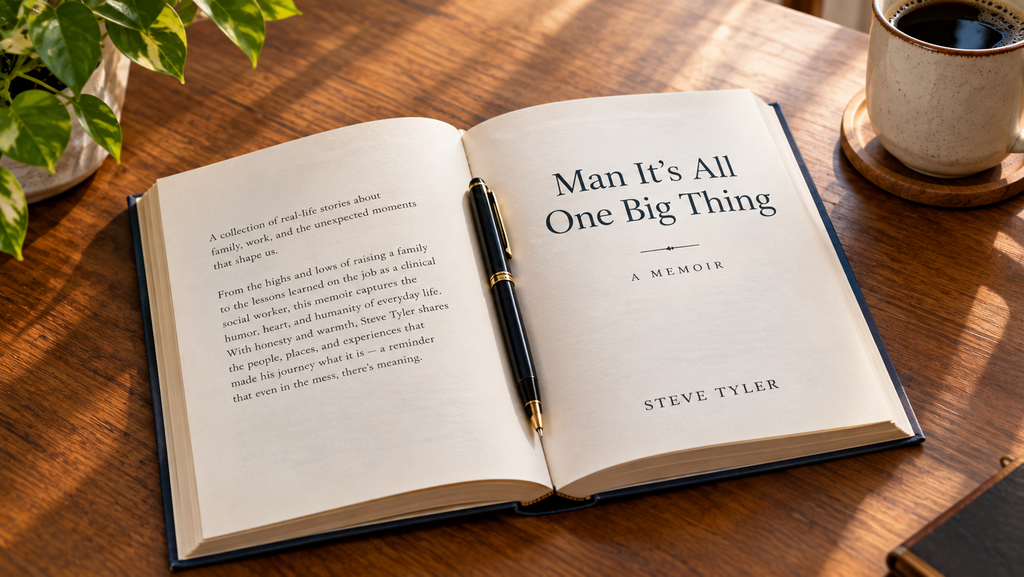
A social worker sits across from people at their worst moments. So you learn fast that nobody’s story fits into a neat box. In fact, people contradict themselves all the time. They laugh at funerals. They cry at weddings. And neither reaction means what you’d expect. So Tyler carried that lesson straight into his writing, page after page.
One reader, Thomas B., said it well in his review. Tyler’s background shows up, but not in a clinical way. Instead, it shows up as real curiosity about people. He also refuses to judge them, himself included. And that’s not a small thing. After all, plenty of memoirs punch down at family members. Some even dress up regret as wisdom. But this book skips both moves entirely.
The Modern Memoir Author Behind The Voice
A modern memoir author usually picks a lane. For instance, some go confessional. Others, meanwhile, stick to comedy and keep things light. But Tyler refuses to pick just one. Readers say the chapter called “The Wedding” is funny from start to finish. Then, right next to it, sits an essay about his parents. And one reviewer called that essay quietly devastating.
That range didn’t come from a writing class. Instead, it came from thirty years of home visits and crisis calls. Grief and absurdity often shared the same room. Sometimes, in fact, they shared the same sentence. After all, a social worker can’t choose which emotion walks in next. So this book doesn’t either.
Take “Raising Riley,” a chapter told from the family dog’s point of view. On paper, that sounds odd. But it fits a man who built his career on noticing the quiet angle in a loud room. Often, after all, the quietest voice in the house says the most.
Family As Material, Not Just Backdrop
Tyler married his wife Susan, and together they raised three sons: Joe, Jimmy and Jack. So the boys show up throughout his writing, again and again. They aren’t props, either. Instead, they’re real people who ask hard questions at bad times. For example, one blog essay opens with his son Joe asking if God has rules. And Tyler passed that question straight to his wife.
That habit, admitting he doesn’t know the answer, runs through the whole book. It also fits someone trained to sit with uncertainty instead of rushing past it. Because real families never wrap their questions up neatly, and this memoir doesn’t force that either. Even the funnier chapters carry a little of that same honesty underneath.
The gas can chapter works the same way. One reviewer called it chaos of the best kind. Meanwhile, a related blog post, “In Defense of the Long Spout,” even cites an NPR statistic about spilled gasoline. Tyler uses it to argue against safety regulations. So agree with him or not, that mix of personal disaster and a real source sets a genuine real life experience book apart from something written just to sound relatable.
Why Readers Call This An Inspirational Life Stories Book
You might wonder why a book with a gas can chapter and a talking dog counts as an inspirational life stories book. But the answer probably has less to do with lessons and more to do with honesty. After all, nobody in these pages comes off as a hero, including Tyler himself. For instance, contractor Jim Kabuta worked on the Buffkin house, and Tyler remembers him for wisdom he almost ignored. Likewise, Professor Horace Bannister, once a U.S. Congressman, humiliated Tyler in front of thirty people and somehow still taught him something.
Letting other people look wiser than you is rare in memoir writing. Because most authors, instead, write themselves in as the smartest person in the room. But Tyler doesn’t seem interested in that version of events at all.
A Life Story Memoir Book Built
None of this rests on one big turning point. In fact, no single crisis explains everything here. Instead, this life story memoir book grows out of small things. A hitchhiker named Alfred Brundage caught a ride with Tyler on an Indiana highway back in February of 1981, on the way to a Grateful Dead concert. Home renovations show up too. So do parenting mishaps, along with one very public humiliation, all still worth telling decades later.
Whether that adds up to deep wisdom or just a good collection of true stories depends on what you want from it. Either way, a memoir by Steve Tyler never claims to have life figured out. And that’s likely the whole point of writing it this way in the first place.
Conclusion
So by the end, Man It’s All One Big Thing doesn’t try to convince you that a career in crisis work automatically makes for good storytelling. Instead, it just happens to work out that way here. Because the same skill that made Tyler good at his job, sitting still while someone else’s mess unfolds, also makes him good at telling stories about it. And that’s a harder skill to teach than most writing courses let on.
FAQs
Is Man It’s All One Big Thing based on true events?
Yes. Steve Tyler draws on his own life, including his career as a Clinical Social Worker in Indiana and his family with his wife Susan and their three sons.
Does the author’s social work background come up in the book itself?
Not as a stated theme, but readers and reviewers say it shows through in his curiosity about people and his refusal to judge anyone, including himself.
What kind of stories are in this collection?
A mix. Family chapters like “The Wedding” and “Raising Riley” sit alongside personal essays about a gas can incident, a hitchhiker on an Indiana highway and lessons from people like a contractor and a former congressman turned professor.
Where can I buy the book?
You can find it on Amazon under ASIN B0GR729LQ8. Author Publishing House put it out.